Sri Lanka Reprices Your Carbon Bed
US activated carbon imports ran 8.6 percent lighter through June and cost 10.9 percent more. The delivered price hit $3.57 a kilo, the coconut-shell origins did nearly all of the moving, and the domestic reactivation capacity that would relieve it starts in 2028.
The United States imported 43,201 tonnes of activated carbon in the first half of 2026 and paid $154.2m for it. A year earlier the same six months brought in 47,271 tonnes for $139.0m.
So the country took 8.6 percent less carbon and wrote a 10.9 percent bigger cheque.
That is a landed value of $3.57 a kilogram, against $2.94 in the first half of 2025 and $2.40 across all of 2019. Nothing in the tonnage line explains it.
"If the volume didn't move, who repriced?"
Not everyone, is the answer, and that is the useful part.
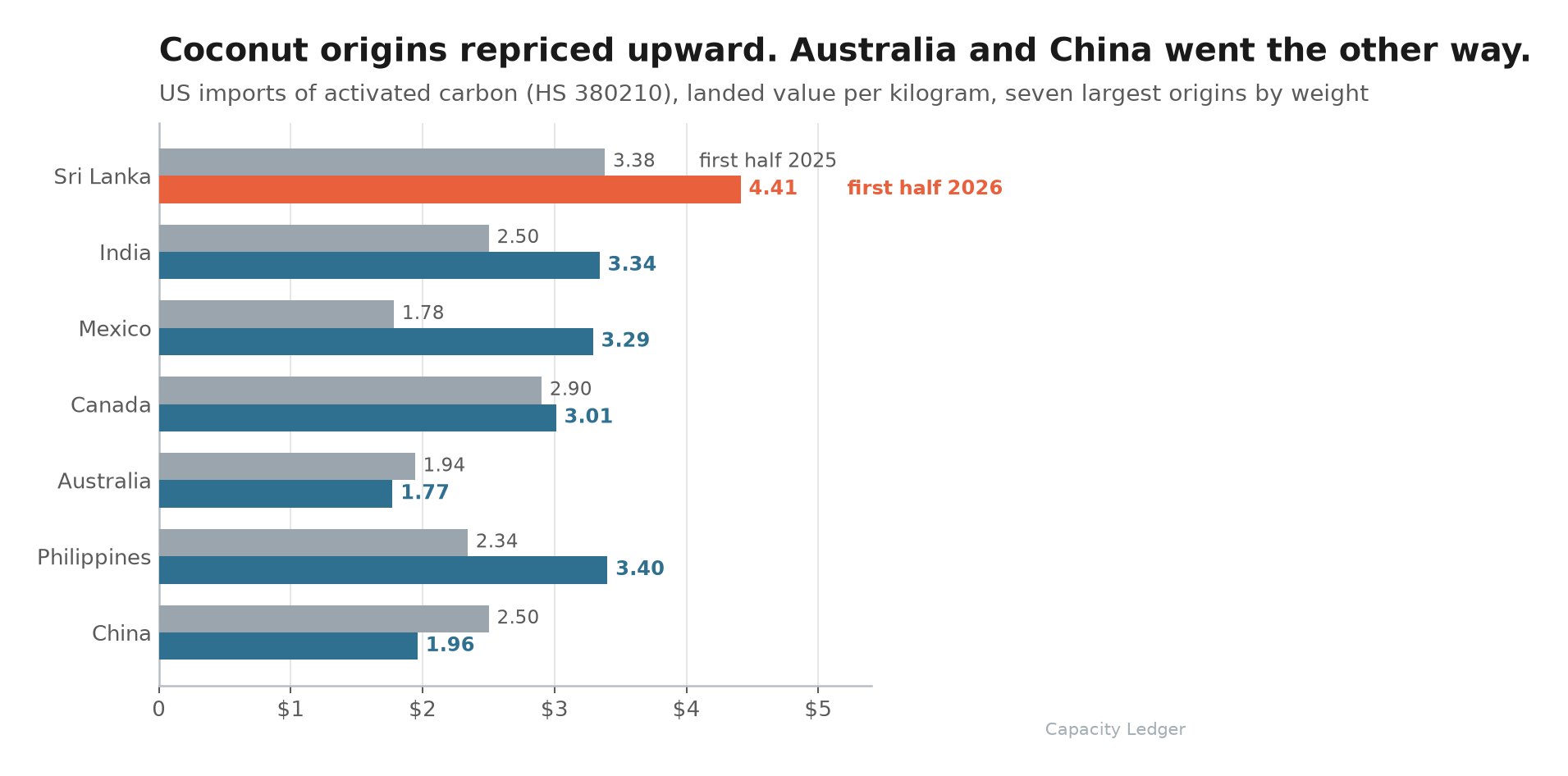
Sri Lanka landed at $4.41/kg, up from $3.38. India went $2.50 to $3.34, the Philippines $2.34 to $3.40, Indonesia $2.01 to $2.67.
Australia went the other way, down to $1.77, and Chinese carbon landed cheaper too (chart below).
Four origins carry the coconut-shell book: India, Sri Lanka, the Philippines, Indonesia.
Together they shipped 21,881 tonnes into the US in the first half, down 18.4 percent by weight from a year earlier, and billed $83.0m for it, up 12.6 percent. Their share of imported tonnage fell from 56.7 to 50.6 percent.
Everything else in the file is a residual.

The rest of this brief is for subscribers.
The capacity math, the trade-flow read, and what it means for the products you buy.
$50 a month, or $400 a year.
Already a subscriber? Sign in