 Capacity Ledger
Why We Started Counting Closures
Closures are outrunning expansions in US specialty chemicals. The launch brief on the database we built to keep score, and the feedstock math behind it.
The defining fact of this specialty-chemical cycle is subtraction. Plants across the US are announcing closures, curtailments, and force majeure faster than anyone is announcing new capacity, and the count has been climbing for years (chart below).
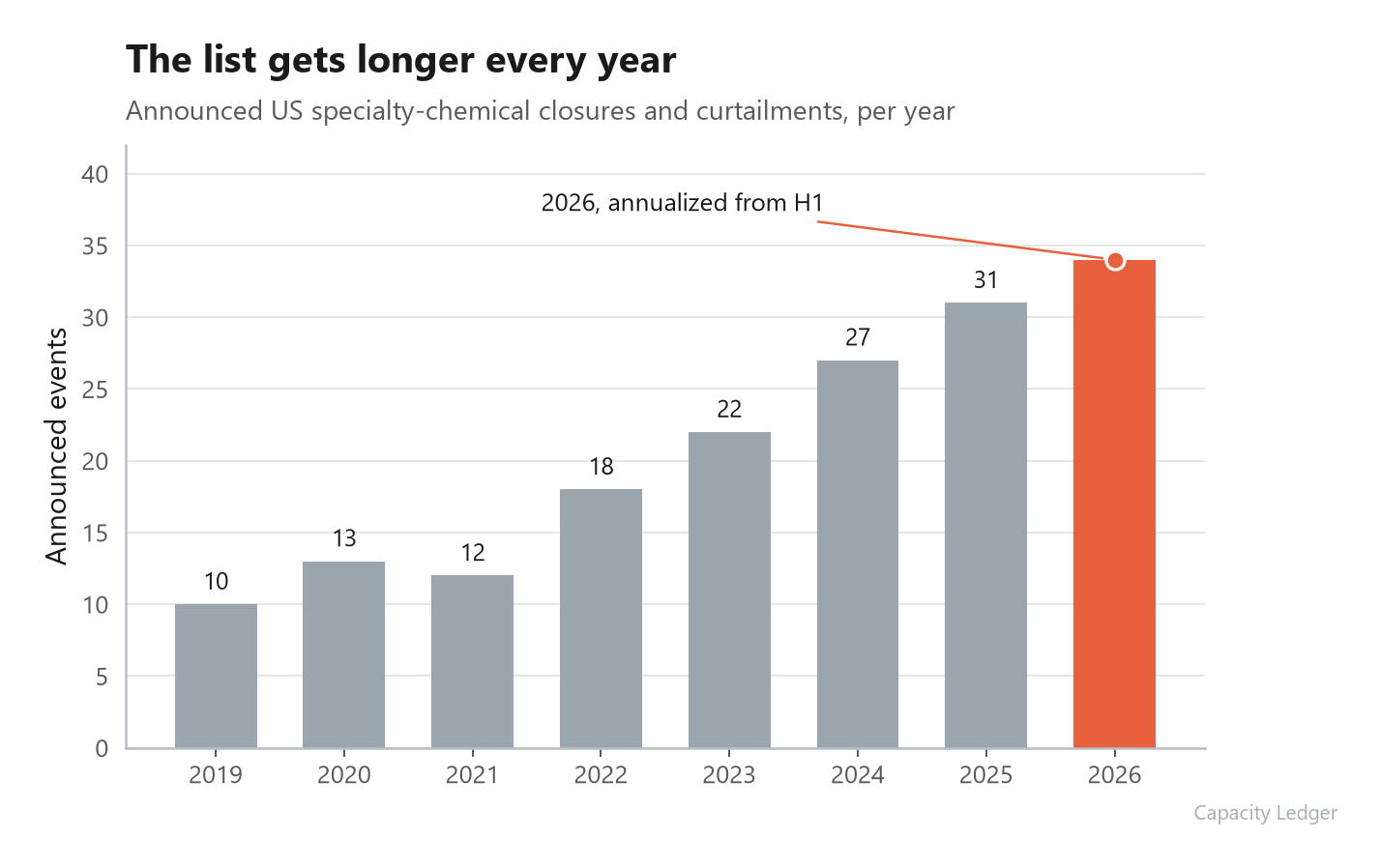
Every one of those announcements is an edit to a supply curve. A line comes out, the volume it carried has to land somewhere, and the buyers who leaned on it learn what "somewhere" costs about a quarter later, in a nomination letter.
That gap, between the press release and the price you actually pay, is the reason this letter exists.
"Who actually absorbs that volume when a sole-source plant goes dark?"
The trade press will tell you a plant closed. Almost none of it will tell you which sites pick up the slack, at what utilization, or whether the grade you buy can even come from the survivors.
That is a supply-side accounting problem, and nobody was keeping the ledger.
So we started keeping it.
What We Actually Built
Capacity Ledger runs on a living database of every announced closure, curtailment, expansion, and force majeure in US specialty chemicals. The build is boring on purpose:
- Scrape the primary record rather than the recap: 8-K filings, earnings-call transcripts, state WARN notices, and air-permit dockets.
- Classify each event by type, site, and the product lines it touches.
- Pull how much of that product the US already imports, using USITC trade data.
- Check who the surviving producers are and how much headroom their utilization leaves.
- Translate the whole thing into a plain read on what the buyer of that product should expect.
A closure usually shows up in one of those primary sources weeks before it reaches a headline. Steps two through four are the work the free digests skip and a busy desk cannot do by hand every week.
That mapping is the point. A shutdown only matters to you if it hits a grade you buy and the import math is already tight.
The Other Half Is Feedstock
A closure tells you capacity left the system. It rarely tells you why now, and why-now is almost always a margin story.
So the second thing we run is a set of feedstock-margin dashboards, built from EIA and FRED data across the chains that actually drive these decisions:
- ethane and propane, for the cracker economics upstream of the derivatives
- benzene, for the aromatics chain
- chlor-alkali, where the co-product balance sets the floor
When an integrated producer's spread on a derivative sits underwater for a few quarters, the curtailment that follows is a lagging indicator you could have read in the spread months earlier.
Who This Is For, and What We Don't Do
We write for the people who own the consequences: product and market managers, sourcing and procurement leads, distributor sales desks, and the chem-sector investors trying to price all of it.
You already know what nameplate capacity, a turnaround, and a force majeure letter are, so we will not explain them. Every event we cover lands on the same question, which is what it does to the product you buy.
Now, the honest limit. We are not a price-assessment service.
The proprietary assessment layer (ICIS, OPIS) costs five figures a seat and stays proprietary. What we build is the capacity math, the trade-flow math, and the feedstock spread, in one place, at newsletter prices: the read that tells you which way a price is leaning before an assessment confirms it moved.
Final Thoughts
None of this hands you the exact number on your next nomination letter, and no honest supply-side read claims to.
What it gives you is direction and lead time: which plants are genuinely at risk, which of your grades are exposed when they go, and which survivors pick up the pricing power that shows up on your invoice two quarters later.
We will be in your inbox with one capacity event or feedstock shift at a time, translated into what it means for what you buy. The closures are not slowing down, so neither will we.
Thanks for reading.